Showing posts with label time. Show all posts

Thursday, April 10, 2014

Improving family relationships


I love my sister Amy. In our family, she is number 7 of 10 children, while I am the caboose. Since
Here are our kids with cousins Rachel and Dara,
during one of Amy's family's recent visits.
there are a few years between us, some of my earliest memories with Amy revolve around her “coaching” me about basketball outside our home in south Texas. While there are many good memories, I don’t know that I felt very close to her or many of the siblings older than her due to the age difference. (The oldest is a different story, but that’s because she was like a second mother to me.)
For many years, due to distance and our involvement in separate pursuits, our relationship never really got any stronger. I still loved her; I just didn’t really know her that well.

Over the last four years, I feel like we have grown closer and developed a better relationship. We still live more than 200 miles apart and see each other only half a dozen times a year, but I know her better than I ever did before. I’ve learned a few things in the process that I think can be applied to all relationships to make them stronger.  

Make an effort
One of the funny things about family relationships is that we spend so much time around each other that we can get on each other’s nerves and see the worst side of each other. We’re on our best behavior in front of friends and coworkers, but don’t hold back around our family. I think we need a place to go and not worry about status or social pretenses, but I also don’t think we need to lash out at our family. We can be good to our family and this may take effort … a herculean effort for some. It’s worth it though.

Think about it this way, sometimes we treat our family badly because we feel they are stuck with us. We feel like we can say anything because they can’t leave us. Our family can leave us, but usually it’s a little bit at a time. If we make an effort to build a relationship of love and respect, we will receive dividends from that relationship for a long time to come. It all starts with commitment. Are you committed to a strong family unit? If so be ready to put in the effort.

Give them time
I don’t know of any lasting relationships that don’t take time. There may be love at first site, but lasting love takes time. I was immediately enamored the first time I saw my wife, but my love grew with each date, conversation and decision that we made together. Now that we have kids and lots of responsibilities, we have to make time for us. When we don’t our relationship gets strained.

When we moved to Kansas City, the three-hour drive to see Amy was long and it didn’t happen very often. But we made good use of opportunities to see her when we could and each visit showed a commitment of time in the relationship, which she has returned by visiting us. It’s hard to know someone you don’t visit or talk to.

A song I like by Josh Groban says, “Time is love. Gotta Run. Love to hang out longer, but I got someone who waits for me, and right now she’s where I need to be. Time is love. Gotta run. Gotta fly, before one more moment gets by.” How we spend our time, is an expression of what’s important to us. Are you giving your family some of your time?

Be interested in what they do
I ran my first half marathon because of my sister Barbara. I ran my first marathon because of my sister Amy. She was training for a marathon and asked if I wanted to run with her. I wasn’t willing to spend $80 on registration and then invest more in shoes and running gear on my own. But when she wanted me to run with her, I thought it would be fun and worthwhile to do something with my sister.

When I try to get the kids to play what I want to play, it’s not as fun as when I follow their lead and play what they want to play. Conversely, it meant a lot to me to have my dad become my basketball coach in second grade, especially because I knew he didn’t have a lot of time. Basketball was my idea (as far as I can recall) and he wanted to support me in it. Do you know what your kids/parents are excited about?

Listen with love
A family therapist I just heard speak at a convention said, “Have a meal with your family at least once a week, and don’t try to lecture or preach to them. Just talk to them about your day, and let them feel safe and comfortable to share about their day. Tell them about the things that you’re excited about and listen to them when they talk.”

Dinner can include meaningful conversations, but don’t stress if your kids don’t want to have deep conversations or have a therapy session at the dinner table. We are trying to teach our kids to take turns and not interrupt. Each gets a turn to share their “guess what’s” and other silly stories … as long as there is some eating going on. I think eating together once a week is not good enough to establish good strong lines of communication and love, but it’s a start. Daily conversation about simple things will make difficult conversations easier. They know you will listen and you will understand them better because you have been listening. Can you listen to a full story without butting in or multitasking?

Next week: What makes a healthy home?

Saturday, December 7, 2013

Family Traditions

What makes holidays, birthdays and any other significant day on your calendar different from the other days of the week? Traditions.
The Christmas tree can be a beautiful tradition,
especially when you teach the symbolism
behind it and the various decorations.


This was particularly clear to me when I lived in Korea for two years. Korea had been a Buddhist dominant culture for many centuries. Christianity had only become a significant part of their civilization in the last fifty years or so. To this day, I think only half of the people consider themselves Christian. So as you can imagine, Christmas was not as big a holiday as it was here in the US. Easter was the same way.

The Fourth of July, the fourth Thursday in November and many other holidays were understandably not celebrated because they hold no significance for the Korean people.

They do have a Chinese New Year, and their own Day of Harvest celebration, which were big holidays. Each was complete with special foods prepared just for the occasion. They would have games, songs, and stories they tell on those days. And best of all, they would spend the day with their families. Sound familiar?

Why are Traditions Important?
No matter where you live, traditions play an important part in our lives. For example:

·         With all the changes a new college student goes through, their first Thanksgiving or Christmas back is usually really special. It reminds them of years before and reestablishes a familiar element in their world of change and often instability.
·         For newlyweds trying to figure out their own traditions, they can decide together what traditions they will keep. It can be a union of the best concepts and practices from both families. They can create their own traditions that are important to them. This is part of establishing their own identity as a new family.
·         For more established families, traditions offer an opportunity to teach. Parents can discuss how they observe that holiday and the reasons behind the traditions. Traditions help teach kids about reverence, honor and beliefs.

The traditions I remember best were centered around family. I would run with my dad on Thanksgiving morning. I loved the noisy conversation around our Thanksgiving feast. I cherished singing Christmas songs around the piano with my family. I looked forward to playing games through the night with my family on New Year’s Eve.

These events and many others helped develop strong family ties that continue to be strong today. I want those ties to be equally strong for the next generation, so Catie and I are creating or continuing family centered traditions for our family.

Traditions are a great way to teach our family. When we take time to discuss why we celebrate Thanksgiving and then discuss what we are thankful for, we help teach our kids to be grateful. When we focus our Christmas traditions around Christ, we teach our kids to focus on Christ and not on Santa. When we focus on Christ at Easter, we teach our kids to hope for Salvation because the Tomb was empty.
The opposite is true too. If we center all of our traditions on whimsical ideas, we shouldn’t be surprised when our kids are disappointed by those traditions in the future. (Just wanted to throw that out as food for thought.)

Everyday Traditions
Traditions don’t just apply to holidays. Sabbath observance can be a tradition in a way. In the Ten Commandments, the Lord said to keep the Sabbath holy. The Jews then created a long list of laws and rules for the Sabbath. Nowadays, what we do on the Sabbath each week is largely up to us. For my family growing up, we went to church, spent time together as a family and mostly kept the TV off. We often wore our “Sunday best” all day to help us remember what day it was. We also had a tradition of reading the scriptures and praying together as a family each day. The overriding lesson I learned through all of this was that God and family are so important we set aside time each day and then a whole day each week to spend with them.

Now Catie and I are trying to establish our own traditions. We travel to see family. We tell the story of Pilgrims at Thanksgiving and count our blessings. We focus on Christ and emphasis that Santa’s giving is a symbol of the gifts the wise men brought to the Christ Child. We read the scriptures and pray together every day. We want the traditions we keep to reflect our values.

What traditions do you remember best from your youth? What are your favorite traditions now?


Next week: Christ in Christmas

Tuesday, February 19, 2013

Involving the Family in Service


Scouts in Twin Falls, Idaho, attach inner tubes to
scrap metal found in the Snake River Canyon,
so it can be floated down the river to a dock.

One Monday night, I wanted to teach my kids about love and showing love through service. At first I wasn’t sure how to make it fun so my 5-, 3- and 1.5-year-old kids would not only understand but enjoy the lesson. I also wanted to make it something we did, not just talk about.

So I told them a story about a little boy named Heber, who got a new red coat. He then gave that coat to a little boy who had no coat at all. When his mom asked about his new red coat, Heber explained what he had done, fearing she would be upset. His mom wasn’t upset but happy he thought to do something to help this other young boy. There is actually a video about it, so we watched the video and talked about the story.

Then each of us cut out four hearts (the 1.5 year old is mostly just going through the motions for the rest of the lesson). I told them that service is a way to show love for others. We are God’s hands when we take time to serve other people. I explained that we should all look for ways to serve each other. When we did service for one of our family members, we would leave a heart for them.

My 5 year old was really excited about this, and she asked for ways to serve immediately. My 3 year old was also very excited and wanted to help too. My daughter asked to make her brother’s bed, read to the youngest and made lunch for me one day. After each act of service, she left a heart. My 3 year old son wanted to help his mom, by putting away her clean socks. He did his best to help make our bed and left a heart for me.

I loved to see the heart in my lunch and on my pillow. I loved to see them excited to help each other. The great part was when the hearts were all given out, they still did service for their family. The simple activity helped them enjoy service and they started to look for ways to serve.  

Any time someone goes out of their way to serve someone else and does it out of love, I believe God gives him or her an increase in love. 2 Timothy 1:6-7


Metal is pulled out of the river at the dock
and taken to a junk yard.
God also gives other blessings when we serve, including knowledge and understanding. Over the years, I have learned how to love orphans, quilt, reroof a house, use a chainsaw, build tables, and float trash metal out of a canyon through service projects. I also learned how not to cut a junk car apart on a canyon wall, but that’s a story for another time.

Service gives you understanding as you interact with other people. It gives you hope and helps you forget your struggles. The interesting part is when you serve others, your problems are more manageable; life gains new perspective. It also helps your kids too.
According to the National Service Learning Clearinghouse organization, kids that have parents who help others and encourage their children to help others are “more likely to internalize prosocial values and attitudes and to help others when they grow up, including responsibility, empathy, and caring for others.”

NSLC advocates integrating service into learning curriculum for all ages, kindergarten through college. They also explain the importance that parent’s play in making service a way of life and not just a random act.

“When parents nurture their child’s sense of compassion and commitment toward their community, we build a better world for now and for the future,” the NSLC website continues. “While doing important community work—feeding the hungry, recording oral histories with elders, working for human rights—service-minded families are raising children and teenagers who are more likely to become civically engaged, thoughtful, caring, and generous adults.”

Don’t forget to talk about service afterwards. Share your feelings, and ask your kids how they feel as they serve. This helps them reflect on what they did and gives them a chance to build on the learning they experienced as they served. A nonprofit called Doing Good Together has some resources to aid in reflecting.

I have to agree with Steven Covey, who said,

"Can you imagine anything more energizing, more unifying, more filled with satisfaction than working with members of your family to accomplish something that really makes a difference in the world?"

Next week:  Attitude with Children

Friday, January 4, 2013

Family Virtues – Thrift and Industry


My daughter and I work on planting flowers
in front of our house.
I am the youngest of 10 children. My siblings joke that I got everything. I did get everything, right after they grew out of it or didn’t use it anymore. Hand-me-downs and left overs were common fair growing up. While I was not oblivious to our situation – my friends often asked me to come to their houses because they had better toys – I didn’t feel cheated or unfortunate. There was always something to do, work to be done and family around.

Thrift
At least initially, thrift brings to mind pinching pennies and hording money instead of having fun on a whim. While that may be the case, thrift can also mean creativity and patience. Let me explain.

One day when I was probably 11 or 12, I wanted to build an extensive wildlife model for my expert project. I was going to present to my class about big cats (lions and tigers and leopards, oh my!). I wanted to have a really cool show-and-tell to make my presentation awesome. I had the cat figurines, but I needed to make the rest of it. My mom was great when it came to encouraging my creativity. If I said I wanted to fly to the moon, her response would have been, “OK, let’s see how we can make that happen.”  Then she would help me come up with ways to create my own adventure.

With this project I wanted everything to look authentic, so I wasn’t really excited about going outside and collecting the branches, sand, and rocks to recreate my scenery. I thought to myself, can’t we go to the store and buy some cool scenery to help with this project, instead of dumping dirt in a cardboard box. However, I knew that wasn’t necessary and as we looked at pictures and put the model scenery together, I was even more excited about my project.

We see all around us the woes of people and organizations that can’t spell budget, much less live by one. Girls and boys who grow up saving, planning and creating with what they have, will know how to live within their means later in life. Those boys and girls will know that money doesn’t solve problems, but is a resource to be used wisely.

Children that learn to save and be thrifty will learn patience, goal setting, self-reliance and even creativity (if they try to do more with less). We could use a lot more of that in our society.

Industry
Work is a four-letter word, but it’s a good one. A family that works together has a strong future. They not only will provide for their own needs, but they will establish habits that will bless their lives, and future generations, for years to come.

I always admired my dad’s work ethic. He never seemed to quit. The sun quit long before he did, so he brought out lights so he could keep on working. In my early teen years, I considered it a great accomplishment if I could outlast my dad in working outside.

His example also taught me to learn and apply that knowledge to overcome obstacles in life, whether it’s car troubles, acquiring skills or just persevering when times got tough. I know when I need to pay an expert, but even then I ask questions and try to find ways I can work out my own problems.

We’ve all heard the saying: Give a man a fish and he will get hungry again. Teach a man to fish and he will never go hungry. Parents are responsible for teaching their children to fish. Boys and girls should know how to work and even find joy in their labor.

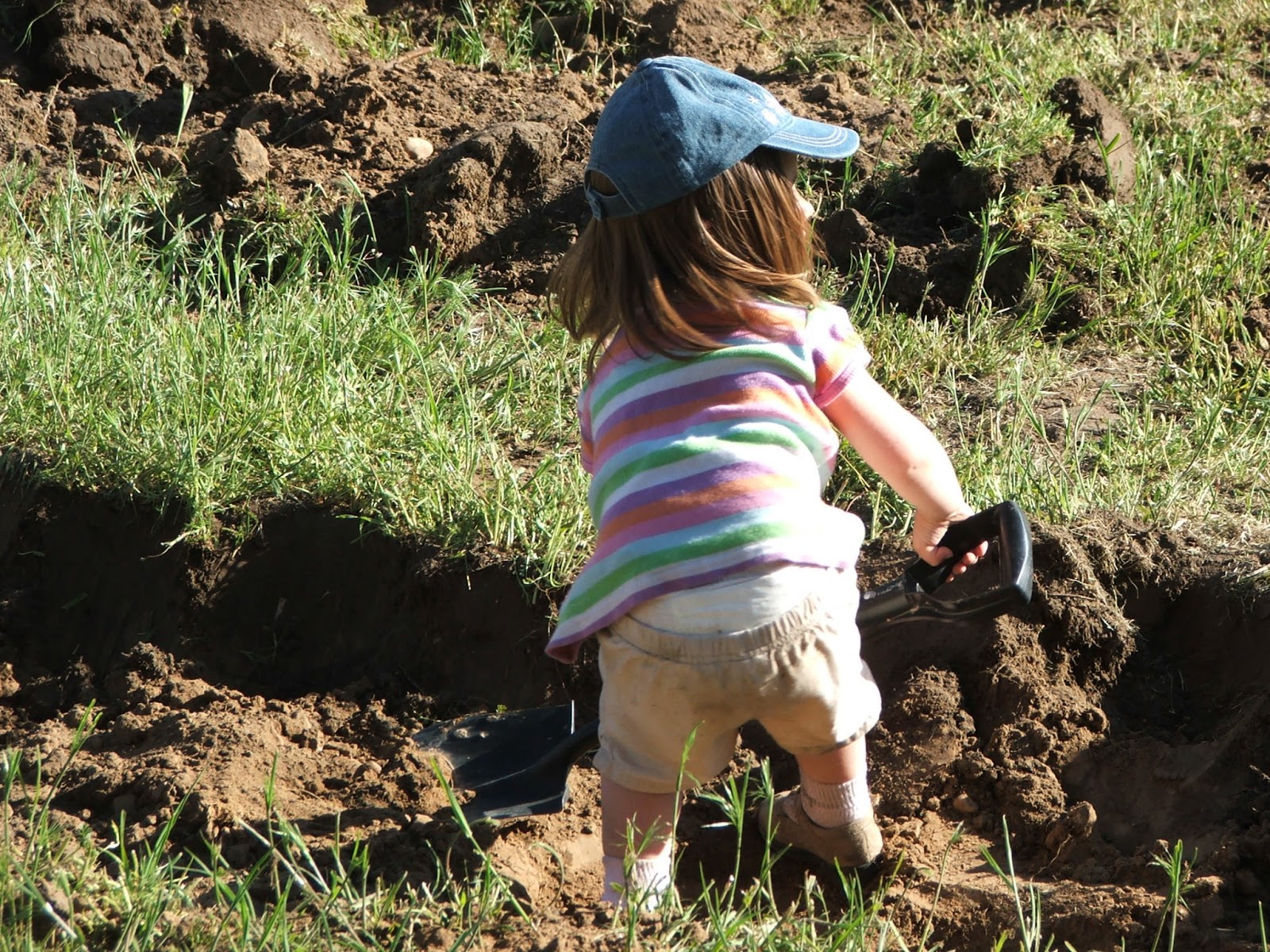
My niece pitches in to dig a trench for a sprinkler system.
Work is empowering and builds confidence. Work will also help them get through tough times, because it gives them something to focus on rather than self-pity and will lead them to a solution. Our great nation was built with hard work, and has survived disaster through hard work. Don’t let your family be a stranger to industry.

In his autobiography, Benjamin Franklin summarized well the importance of thrift and industry. He said:

“Waste neither time nor money, but make the best use of both. He that gets all he can honestly, and saves all he gets (necessary expenses excepted) will certainly become rich; if that Being who governs the world, to whom all should look for a blessing on their honest endeavors, doth not in his wise providence otherwise determine.”

God will richly bless families that save and work together with more than just worldly wealth. In the parable of the talents, the servants that put the money to good use and worked hard were given more. The one who hid his money and didn’t put it to good use, was scolded for being slothful and had his talent taken away. The first two servants not only became rulers of many things, they also gained knowledge no one can take away.

Next Week: Family Virtues – Optimism

Friday, December 14, 2012

Family Virtues – Learning


Reading together improved literacy for the next generation.
Santa hats optional, but encouraged. :)
“How do you spell ‘accept’?” said my mother after an all night shift at the hospital and only a few hours of sleep. Even though I was young, I knew she was tired and if I waited long enough, she would fall asleep.
“A (pause) c (pause again) s (check her facial expressions to see if I messed up. Oh no, she’s shacking her head, try another letter.) c …” I would say it as slow as I could without making it obvious.
I remember spelling homework going like that frequently. My attempts to get out of homework diminished a lot having to repeat second grade after my original attempt. I was held back because I wasn’t performing like my parents knew I could. From that point on, I played less and focused more.
I want to point out a few things that I learned over the years from these experiences.
  1. I went to school to learn, but my parents were going to follow up.
  2. School was important enough that my mom would miss sleep to make sure I got my homework done. Over the years, this was true of both parents, as they wouldn’t go to sleep, if one of their children was trying to finish a project.
  3. There was an expectation for my effort and performance. Socially this was hard, and I was reminded of it frequently over the next few years when I would see kids I knew in the older grades, and they saw me. My parents wanted me to be grow for the future, not be comfortable in the present.
Family is the ultimate classroom. No matter where your child attends school, public, private or homeschool, the family will always be the most important part. No one will have as great an impact on the student’s learning as his or her parents. We need good teachers, and good school systems, but even the best academic institution cannot and should not try to replace the parents.
A recent study by the Joan Ganz Cooney Center at Sesame Workshop and the New America Foundation found that only a third of fourth-grade students read at their grade level. Of those only one in six qualify for free school lunches. The study found that the most important factor in their reading ability was parent and student interaction.
It makes sense though, right? If a child sees that reading is important and encouraged at home, then she is much more likely to want to read herself. Research shows a strong correlation between good academic performance and parents with college degrees. If a parent is engaged in the school process with his child, then the child is much more likely to want to excel.
So parents need to follow up with their children after school. Talk to them about what they learned. Show interest in them and their success by giving them your time and attention. Slow down and read with your kids, and ask them what they learned from the book.
In the Old Testament, we learn that Daniel and his friends were selected for their wisdom and understanding. But at least the four we know about, stayed true to the knowledge they received from their parents. They rejected the false traditions of the Babylonians and were blessed with even more knowledge.
Moses gave the charge to the Israelites to teach their children during the feasts. Their children hadn’t seen the Lord part the sea. God wanted the next generation to learn, that he has power to help them.
“And that their children, which have not known any thing, may hear, and learn to fear the Lord your God, as long as ye live in the land whither ye go over Jordan to possess it.” (Deut. 31:13)
Parents can’t assume someone else will teach their children, or that those teaching will always teach what’s right. The current curriculum may not be what you want your child to think is the gospel truth. God gave you those children, you have a solemn responsibility to teach them truth and virtue.
Over Thanksgiving, I had a special experience with my 5-year-old daughter. We went for a walk together through a lightly wooded area. I picked up a seed and talked about where it came from, how it became a tree and how that tree made more seeds. We climbed trees and talked a little about what trees “eat” and how they get energy from the sun. Then we told stories to each other about adventures in the woods. She won’t remember what I told her, but she will remember me taking time to be with her and how we asked questions about the world around us. I hope to have many more experiences like that with her and my other kids to make learning fun.

Next week: Family Virtues - Forgiveness and Mercy

Thursday, October 25, 2012

Learning from Children


Left to Right: Nathan, Caityln,
Samantha (cousin) and Hailey (cousin)
Kids teach some great lessons about life. I also learn a lot about God through my relationship with my kids. Below are a few stories and what I learned through those stories.  

Love
Our little girl has a big heart. When her brother fell and scraped his knee, she would run to her brother and ask him if he was OK, help him up and give him a big hug to help him calm down. She does it because she loves him, not because she has to. Other times she will sit with her brothers and look at books with them, not because she has to but because she wants to.
Our two younger boys are can be quite loving too. For no reason at all they will walk up to each other and give each other a big hug, grinning ear to ear. They will frequently run to me when I get home from work and yell, “Daddy, Daddy!” with arms wide open. They give me a squeeze and smile, just to say they love me and missed me.

Patience
Children are a huge tutorial in patience. Not that they are always patient, but they require patience.
Patience is learned when you know it will take twice as long to eat when the toddler is holding the fork, but they need to practice. Patience is required to let your three year old take his turn brushing his teeth so he develops the habits, even though you will need to take a turn so his teeth actually get clean. Patience comes from watching your five year old brush her hair, even though she may take ten minutes on one spot and think she is done.
Patience really comes when you realize the joy in seeing them each succeed at learning new skills. Kids help you put life into perspective. The kids are far more important than the mess, the technique or the completeness of the job. They will accomplish more when we love them through it all and show it.

Forgiveness
Unfortunately, I have not always shown my love and been completely patient with my children.
One evening, I was tired and irritable. I wasn’t in the mood for making big bubbles with our hands as we washed them. I wasn’t willing to wait for my 3 year old to check between each toe for toe jam before he got his pajamas on. I was annoyed with each delay and voiced that annoyance a little louder with each detour. About the time the kids decided it’s time to play hide and seek, rather than get in bed, I lost my temper and wasn’t nice with my words and probably promised punishment I knew I couldn’t follow through with. I left and my daughter was crying. About 5 minutes later, I had calmed down and put things back in perspective and went to apologize to the kids.
Although she reminded me that I should talk nicely, she was quick to return the hug and say “I love you.” I knew she had really forgiven me. When someone comes to me and says “I’m sorry,” I know I should forgive and forget like a little child.  

The activity is not that important as long
as we are doing it together.
Time is Precious
I try to leave my Saturday’s open for family time. I love to be with my kids. When I ask them what they want to do, the suggestions range from wrestling and building with blocks to playing house and reading books. My children are young, so maybe this will change, but the activity is not that important as long as we are doing it together.

Children are Heavenly
I have learned a lot about my relationship with God as I reflect on my relationship with my kids. I know many times how my child will react to something, before I ever tell them. I know some news will be hard to accept, i.e. “It’s bed time.” As their father, I know what they need and I will help them get what they need, but I want them to put forth effort too.
 My Heavenly Father knows me perfectly and knows how I will react, and he has placed growing opportunities in my path, so I can grow. He won’t give me a trial I can’t handle. Even when we are facing a difficult trial, he is ready to help us get through if we turn to him in faith.

My kids teach me many more things, but these are a few things that help me understand what Christ meant when he said, “Whosoever therefore shall humble himself as this little child, the same is greatest in the kingdom of heaven.” (Matthew 18:4) Or what Paul meant when he told the Corinthians, “Brethren, be not children in understanding: howbeit in malice be ye children, but in understanding be men.” (1Corinthians 14:20)

Next week: Family Virtues – Love