Showing posts with label Jesus Christ. Show all posts

Monday, December 23, 2013

Putting Christ in Christmas

When we try to follow the Wonderful Counselor, we learn
the wisdom of His ways.
I love Christmas. I loved it as a child and I love it now.  There was a time when I was a teenager that Christmas was not very exciting or magical. I needed to rediscover what Christmas meant.


I’m not sure exactly the age when I started to feel empty at Christmas, but I know it was when most of my siblings were gone and Santa was a distant memory. I didn’t have anything to look forward to, and my Christmas list became more and more expensive, therefore, less and less of my list appeared on Christmas morning. It’s not that I didn’t like Christmas, I just wasn’t looking forward to it like I once had. I felt empty.

I remember asking myself, ‘what’s wrong with me? I should be happy at Christmas.’ As the years passed and I matured, I started to understand the problem wasn’t that my desires weren’t being met. It’s that my desires were completely selfish. It’s not that my parents weren’t providing for me or loving me. The problem was that I was not loving others or helping others like I should. I was so focused on me that I forgot Christ in Christmas. I was celebrating “MEmas!”

I never stopped believing in Christ. So it’s not that I forgot the story behind Christmas and its origins. I knew Luke 2 well and could tell anyone what happened that incredible night in Bethlehem. So why was I not finding joy at Christmas?

A Son is Given
Like I said, the problem was that I was self-centered, not Christ-centered. And part of the problem was that I only looked forward to the presents. As a child, it seemed like anything was possible on Christmas. I could get anything. (I’m not sure why we don’t have that same feeling on our birthdays, but I think it might be because a magical man in a red suit isn’t giving us birthday presents, but I digress.)

I was missing the fact that the best gift ever given was the Christ child. I did not appreciate what his life and resurrection meant for mankind and our eternal salvation. I still don’t fully appreciate it, but if I understand it a little better each year, Christmas will always bring me joy.

Now I try to figure out something I can give to Him. He doesn’t need gold or precious oils. Christ wants a humble heart and willing mind.

Wonderful Counselor
Christmas no longer felt empty when I focused on making Christmas special for others. I think that’s part of why Christmas is fun for parents, because we are focused on doing something special for our kids. Because we are celebrating the Saviors birth and life, we should spend time doing what he would do; serving others, visiting the sick and helping those in need.

For the last couple years, we have put up a small manger in our living room. We tell the kids a story about a family that tries to make the manger soft for Jesus through service. In the story, the family would draw a family member’s name and try to do an act of service for that person. Each act of service let them put a straw in the manger. Then by Christmas, Jesus will have a soft bed to sleep in. We practice a modified version of this tradition. Our kids are still small, so we have to help them recognize opportunities to serve, so Catie and I just try to point out service opportunities. They are excited about making a soft bed for Jesus and now the service is natural. They forget to put in the straw most of the time.

The funny thing about helping others is that it helps the giver as well as the receiver. When I spend a couple hours at the food bank, I feel more grateful for what I have and more compassionate for those who need the food bank. When I take time to shovel someone’s driveway, I feel love joy in helping someone. When I call up someone I know is sick and ask how they are doing, I feel more gratitude for my health and compassion for a friend.

These acts and feelings bring us closer to Christ. When we try to follow the Wonderful Counselor’s example, we learn the wisdom of His ways.

The Prince of Peace
Now that I have peace and joy at Christmas (most of the time), I am trying to teach this to my kids. It’s not that Santa is a bad thing, we just try to downplay his role. We try to emphasis Christ’s story and why it’s important. We try to learn from his life and what he did. We spend time talking about the symbols of Christmas and how they can remind us of Christ.

I don’t want my kids to feel empty on Christmas. I believe the best way to do that is fill them with the best news the world has ever received.

“For unto you is born this day in the city of David a Savior, which is Christ the Lord.”

His life and love can fill us and our families with peace if we will learn of Him and follow Him. How you reach that goal in your family is up to you, but I do hope you make that the goal this year and every year.

Merry Christmas!


Next week: Improving family relationships

Saturday, December 7, 2013

Family Traditions

What makes holidays, birthdays and any other significant day on your calendar different from the other days of the week? Traditions.
The Christmas tree can be a beautiful tradition,
especially when you teach the symbolism
behind it and the various decorations.


This was particularly clear to me when I lived in Korea for two years. Korea had been a Buddhist dominant culture for many centuries. Christianity had only become a significant part of their civilization in the last fifty years or so. To this day, I think only half of the people consider themselves Christian. So as you can imagine, Christmas was not as big a holiday as it was here in the US. Easter was the same way.

The Fourth of July, the fourth Thursday in November and many other holidays were understandably not celebrated because they hold no significance for the Korean people.

They do have a Chinese New Year, and their own Day of Harvest celebration, which were big holidays. Each was complete with special foods prepared just for the occasion. They would have games, songs, and stories they tell on those days. And best of all, they would spend the day with their families. Sound familiar?

Why are Traditions Important?
No matter where you live, traditions play an important part in our lives. For example:

·         With all the changes a new college student goes through, their first Thanksgiving or Christmas back is usually really special. It reminds them of years before and reestablishes a familiar element in their world of change and often instability.
·         For newlyweds trying to figure out their own traditions, they can decide together what traditions they will keep. It can be a union of the best concepts and practices from both families. They can create their own traditions that are important to them. This is part of establishing their own identity as a new family.
·         For more established families, traditions offer an opportunity to teach. Parents can discuss how they observe that holiday and the reasons behind the traditions. Traditions help teach kids about reverence, honor and beliefs.

The traditions I remember best were centered around family. I would run with my dad on Thanksgiving morning. I loved the noisy conversation around our Thanksgiving feast. I cherished singing Christmas songs around the piano with my family. I looked forward to playing games through the night with my family on New Year’s Eve.

These events and many others helped develop strong family ties that continue to be strong today. I want those ties to be equally strong for the next generation, so Catie and I are creating or continuing family centered traditions for our family.

Traditions are a great way to teach our family. When we take time to discuss why we celebrate Thanksgiving and then discuss what we are thankful for, we help teach our kids to be grateful. When we focus our Christmas traditions around Christ, we teach our kids to focus on Christ and not on Santa. When we focus on Christ at Easter, we teach our kids to hope for Salvation because the Tomb was empty.
The opposite is true too. If we center all of our traditions on whimsical ideas, we shouldn’t be surprised when our kids are disappointed by those traditions in the future. (Just wanted to throw that out as food for thought.)

Everyday Traditions
Traditions don’t just apply to holidays. Sabbath observance can be a tradition in a way. In the Ten Commandments, the Lord said to keep the Sabbath holy. The Jews then created a long list of laws and rules for the Sabbath. Nowadays, what we do on the Sabbath each week is largely up to us. For my family growing up, we went to church, spent time together as a family and mostly kept the TV off. We often wore our “Sunday best” all day to help us remember what day it was. We also had a tradition of reading the scriptures and praying together as a family each day. The overriding lesson I learned through all of this was that God and family are so important we set aside time each day and then a whole day each week to spend with them.

Now Catie and I are trying to establish our own traditions. We travel to see family. We tell the story of Pilgrims at Thanksgiving and count our blessings. We focus on Christ and emphasis that Santa’s giving is a symbol of the gifts the wise men brought to the Christ Child. We read the scriptures and pray together every day. We want the traditions we keep to reflect our values.

What traditions do you remember best from your youth? What are your favorite traditions now?


Next week: Christ in Christmas

Thursday, August 8, 2013

Dealing with Anger

We may never be able to stop getting angry,
but we don't have to let our anger control us.
I have a question that might seem obvious, but I want you to think about it.

Can you live free from Anger?

Now you might be thinking, “Anger is an emotion and we all feel anger. So the answer is obviously, No.”

To that I say, read the question again and think about it’s really asking. I’ll give you a second to read it again.

The question doesn’t say, “Can you live without anger?” The question is “Can you live free from anger?” meaning “Can you live without being controlled by anger?” To which I would say, Yes you can, and should, live your life without being controlled by anger. But first let’s talk about anger.

What is Anger?

Anger is the emotion we feel when personal boundaries have been violated. This is different for everyone. What makes me mad may not make my wife mad. Anger isn’t really a primary emotion; it’s a reaction to something that has happened that threatens our personal worth, essential needs or basic convictions. We use anger to protect ourselves and it gives us energy to find a solution to the problem. (Many definitions are based on the “Married and Loving It” class manual written by Barbara D. Petty Ph.D and Rev. Terry W. Petty)

What do we do with Anger?

As I mentioned before, anger is energy we create to help us solve a problem. It’s whether we choose to control that energy and use it constructively or not that determines whether or not we make the problem worse or solve it.

Dealing with Anger

There are some basic steps to dealing with Anger and not letting it control you. First, you need to figure out what caused you to get angry. Second you need to figure out a solution. And third you need to forgive.

Figuring out what got you angry in the first place can be kind of tricky. Most people will say something like, you hit me so I am mad at you. Anger was actually triggered by the violation of a personal boundary and an attempt to preserve an essential need (safety). When you can boil it down to what really caused you to get angry, you will be much more likely to resolve and forgive. If you start by blaming, you will associate the negative feeling with the person, and that makes it much harder to forgive.

The second part is finding a solution. This means you need to address the problem, not suppress it, become aggressive, or manipulative to those involved. Good anger resolution comes from assertively, yet positively expressing your anger. This takes a lot of self-discipline, but ultimately helps you come to a positive solution. There are times when there isn’t anything you can do about it, which brings us to forgiveness.

In order to forgive, you need to step out of your shoes and into the other person’s shoes. You have to recognize your own limitations and imperfections. You need to decide that your anger won’t hold you down, and you are going to forgive the other person.

When I discussed this topic with my brothers, sisters and friends a few years ago, some of them asked about righteous anger. Most of us probably consider righteous anger as justified anger (don’t we all feel justified when we are angry?). The example cited was Christ throwing out the money changers from the temple. You could also say that God wasn’t really happy with Israelites many times, he was wroth with them. This is my answer to that.

Righteous anger is hard, as humans, to control. It can quickly just turn into anger. Anger clouds our vision and perspective. To be free of anger doesn't mean that the emotion doesn't exist, it means that we are not controlled by it. Finding the source of the anger, dealing with it and then moving on, like the Savior would do is the ultimate goal. Did the Savior use some force to address the problem? Yes. It must have been necessary, because he didn’t make any mistakes (he also had a much better understanding of the situation than we do). But didn’t he also forgive everyone, even paying the price for the sins they committed? He never lost control and he always loved and was willing to forgive.

As Husband and Wife and as Father and Mother, we set the example for our family. We need to learn to control our anger before we can expect it from someone else. If we can help each other and keep working on solutions, while forgiving one another, we will strengthen our marriages and families.


Next week: Practicing Patience

Thursday, April 25, 2013

Finding Answers from God

One of the many neat quotes in the Library of Congress.

Getting a two year old to transition from a crib to a toddler bed is frustrating. 2 year olds aren’t called sit-and-waiters, they are called toddlers. They want to be up and moving around at all times. Cribs are great because they keep them contained. It only takes so long before the limited space becomes boring and they decide to give up and go to sleep.


However, when a toddler becomes a climber, it’s time to move to a bed. Our 2 year old figured out how to climb out of his crib and we didn’t want to be awakened one night to a scream because the escapist fell out of bed and hurt himself.

So the first night of sleeping in a bed had come and I was trying my hardest to figure out how to get this little boy to stay in his bed. Telling him didn’t do it. Bribing didn’t work. Threatening didn’t work for long. What was I to do?

Well I knew this topic was coming up for my blog, so I thought I better put my theory to the test. That is, I believe we can find the answers to our problems in the scriptures if we read, ponder and pray for guidance. So that’s what I did, and it worked. This is what happened.

I went into his room, and sat down on the floor. I pulled out my phone, which has the scriptures on it, and started reading aloud Joshua chapter 1. By the time I got to the end of Joshua chapter 3, my 2-year-old son was asleep. Not exactly a miracle, since reading has put me to sleep many times, but it was an answer to my problems.

Seriously though, we can find real answers for life now by reading the scriptures. And I think it can really help families to find answers this way. First of all, the scriptures contain eternal truth. Second, searching for answers gives us a new perspective. And finally, it develops faith.

Eternal Truth
The difference between eternal truth and man’s truth is how long it stands before being disproven. Eternal truth is established by God and will never be disproven, hence being eternal. Man’s truth is an attempt to make sense of things and is good, most of the time, but it is not complete. So we need to establish our lives on eternal truths. Jesus said it himself, “Therefore whosoever heareth these sayings of mine, and doeth them, I will liken him unto a wise man, which built his house upon a rock:” (Matt. 7:24) We know the parable; no matter what came, the house stood still because it was grounded on a solid foundation. When we base our decisions on eternal truths, we will be much better off.

I must say that we may not always understand eternal truths correctly, but at least we are starting with a pure source. If we continue to learn and try to apply what we know, our knowledge and understanding will grow.

New Perspective
Consulting scripture when you have problems helps you gain a new perspective. When we have a problem, we tend to think about it with only one view point. When we talk to someone else about our problems, they see it differently. This can often help us find a good solution to our problems because we see more options.
The scriptures offer a true story with real outcomes. We get to see two or more sides to a story as the stories unfold. If we think about what we are reading, God can enlighten our minds and we will see our lives more clearly.

Develop Faith
Searching for answers with a prayer in our heart and an open mind is an exercise in faith. As we try to understand God’s will for us and desire to follow that knowledge, we add layers of bricks to that house built on the Rock of our Redeemer. And families fixed on that kind of faith will be able to withstand the storms that will come.

Does It Work?
I have had many experiences but to illustrate what I mean, I want to share one experience. One day I was trying to figure out if I should start a new venture, which I knew would take some time and hard work. Like most people, I am busy, so finding time for this opportunity was a difficult decision. To make matters worse, there was no sure or immediate return on investment of this time. If I did it, I knew that it may be a labor of love more than a labor of monetary gain.

So I started by saying a prayer. I asked God to guide me and help me understand what was right for me and my family. So I opened my bible and started reading. I found a verse that said Ryan will do this that and the other and it will have this result. I closed the bible and lived happily ever after.

OK, it wasn’t that easy and it never is. I did open my bible and started reading. I read a chapter or two and as I reflected on what I read, one part stood out more than the rest. It was relevant to what I was wonder, so I noted that and opened to another section. I read a page or two and realized the theme of the story also related to my decision. This continued a few more times and then I reviewed what I had pondered and read. I tried to understand what it meant and then prayed again. I felt peace and decided I had my answer.

Sometimes, the answer comes in the scripture I read recently rather than just opening and reading, but I do spend some time reading and pondering. As I got more familiar with the scriptures, I knew where to find the stories that were related to what I was going through and then I could find my answers easier.

The moral of the story is God is trying to talk to us and give us understanding. When we listen and try to follow his words, we will not be disappointed. We will always learn.

Next week: Building a stable home

Thursday, April 11, 2013

Attitude with Children - The way we speak.


Recently, I’ve been doing a little experiment. But only I knew about it.

Here is the scenario. My kids, in particular my two boys (an almost 4 year old and a 2 year old), don’t always listen when you ask them to do things. Not only is that frustrating, but human nature says, “if that didn’t work, try saying it again, only louder.” I have done that many times and the volume I end up using sometimes is probably kin to shouting. (Let’s be perfectly clear, I never swear or use degrading language.) I start in a conversational tone, “Please pick up your toys.” Then I say it again with a little more volume and a little more body language. “Please PICK UP YOUR TOYS.” Finally, somewhere between a yell and scream while picking them up and putting them in front of their pile of toys on the floor, I exclaim, “PICK UP YOUR TOYS!”

The rest of the night goes about like this: I feel frustrated because I had to raise my voice, while also feeling justifies because the kids still aren’t listening. The kids are noticeably annoyed with me and are less than amiable with any further requests. In general the mood in the house becomes gloomy and testy and we all can’t wait for bed – well, I can’t wait for them to go to bed, and they don’t want to go to bed, but aren’t as interested in staying up since dad has a burr in his saddle.

So that’s how things would go some nights. It isn’t always that way, and sometimes we don’t always get to dinner before that episode would start, but I didn’t like it and I wanted to change what was going on. I thought long and hard about what I could say to motivate my kids to change their behavior. (Who needed to change, Ryan?) I hadn’t come up with a good answer and that only added to my frustration, but I noticed I needed to do something different.

Proverbs 15:1 A soft answer turneth away wrath: but grievous words stir up anger.  

So, back to my experiment. I was recently reminded of how a woman got the attention of a room full of rowdy kids, and it wasn’t by yelling, threatening or spanking. I was astonished the first time I saw it – actually, every time I saw it.
She quietly whispered.

I couldn’t hear her, at first, but very soon, all the kids quieted down because they wanted to hear what she was saying. So when I was reminded of this through a talk I heard last Sunday, I decided to try it. 

One morning, my 3 year old was in the blinds. I don’t know how many times we have said not to play in the blinds, but there he was doing it again. It did cross my mind to firmly remind him what we expected, but instead I tried saying as quietly and gently as possible, “Son, please get out of the blinds.” He did it right away! I almost gave him a high five and jumped in the air. (It’s the simple pleasures in life. J)

Another night, my daughter got up out of bed and had a few excuses for why she was out of bed. I didn’t change my position, but everything I said was soft and gentle. She didn’t get up anymore, and wasn’t upset with me when she went back in her room.

This actually works with grown-ups too. This blog talks about the “speak softly” technique. Think about it though, who likes to be yelled at or scolded for mistakes? When you think about how the Savior talked to those that came to him. He was clear direct, but respectful and kind. 

Unfortunately, our kids have picked up on this habit of getting louder to make your point. It may take some time to unlearn the bad habit I was teaching my kids.

I think the main take away is obvious: speak unto others as you would have them speak unto you. That usually comes from changing your attitude about the situation. Initially I thought I needed to change their behavior, but I learned that as I changed my behavior, they followed suit.

Next week: Finding answers with God

Sunday, March 10, 2013

Family Culture


Each generation must learn who they are,
and then pass on a heritage for the next generation.
What legacy will you pass on?

A friend of mine from New Zealand named Henry Higgins, served a mission in Korea at the same time I did. He was always happy to talk about his Maori heritage. He beamed as he flashed his tongue, chanted the haka, and shared stories from their culture.

As a new missionary, I was also immersing myself in the Korean culture. I was learning about their language, their history, customs and traditions, which all seemed beautiful and wonderful to me. Since I was going to be serving them, I wanted to know a lot about them and I had a great love and respect for their culture. 

At this time, I was struggling with my own identity though. I had seen a few cultures first hand, in Mexico, Guatemala, Hawaii, now Korea, and I started to wonder about my own heritage. Did I have any cool dances passed down from generation to generation? Did I have any neat stories about courage and survival? Did I have a language my ancestors used to communicate their thoughts and feelings? 

Unfortunately, I felt a void and it made me sad.

After a while, I realized that I did have a great heritage (though I don’t think we have any cool dances like the Haka), and I had forgotten it. I do have great stories of survival and courage from ancestors.
I also realized the most important culture I have is not tied to blood lines but the blood of Christ. The gospel culture of rebirth, faith and devotion to God is a culture that has deeply influenced my family. It’s a culture of love, forgiveness and change through our merciful Lord and Redeemer. 

I know about my Christian culture, but how do I pass it along to my kids?

Share it with a Smile
When I asked Henry about the Haka, he smiled and told me about where it came from and what it meant and then offered to show me how to do it. He was often showing others and was happy to do it. Christians have the gospel or “good news,” and we should share it with a smile to our kids. When I tell my kids about the ultimate sacrifice of Jesus Christ, I want to do it with a smile because of what it means to me. When I explain my reasons for moral and ethical values, I don’t want to pout. I want to gladly explain the reasons I want to live a better life.

Share it with a Song
Music and dance are often outward expressions of cultures around the world. We can put vigor and energy into them that goes beyond simple words. The crescendo in the national anthem stirs my heart and reminds me of my heritage every time I hear it. Similar feelings come when I sing Amazing Grace to my kids at night. My wife and I have set a tradition in our home to sing songs to our kids right before they go to sleep. It’s a nightly reminder of our Christian heritage. The songs I learned growing up became a strength to me when I was afraid, discouraged and struggling. I hope to pass that on to my kids, so they will know where true strength comes from.

Share it with Stories
Every culture I know of has some traditional story about how man was created and the world was formed. Whether it involves tigers or tides, they are passed on from generation to generation. Often they are symbolic of a balance of nature and unseen powers. Older members of the culture feel it a duty to share important events and concepts through stories to the younger generation. I can’t tell you how many times I’ve heard David and Goliath, but I still love that story. I want my children to be very familiar with the Easter story, and many others from the scriptures. As I mentioned in an earlier post, children put themselves in the stories they hear. Tell them good stories from the Christian heritage and they will find the faith they need when they face their own Goliath.

Next week:  Attitude with Children

Sunday, February 3, 2013

Marriage = More than I Do’s


Me on my wedding day. Yes, I can fly.
"When you are the wind beneath my wings."

One night, after my wife and I had a disagreement, I came to an important realization: It doesn’t matter who started it or is at fault, I need to say, “I’m sorry.” This little nugget, though hard to follow at times, has helped us get through many problems. I find it really easy to feel justified in my cause and ready to stand up for myself, only to find out that I am standing in the way of progress in our relationship.

At marriage we often think of the wonderful times ahead. Not all wedding vows are the same, but I imagine most of them have a couple phrases in there about sticking together in sickness and in health, in poverty and in wealth. When push comes to shove, sickness, poverty and other common problems tend to strain marital bonds and even break some.

My wife and I have only been married for seven and a half years. I am well aware I am not qualified to give marital advice. So I will start by saying I am leaning on the experience and wisdom of a man I greatly admire, Gordon B. Hinckley. I have quoted him before, and I think his book, “Standing For Something” is very useful, especially in our current times. (I am not affiliated or reimbursed for mentioning his book, it’s just really good.)

Mr. Hinckley outlines four cornerstones to a strong marriage, the explanations are my own. Marriage is the foundation for the family, so strengthening marriage will strengthen the family.

1. Mutual respect and loyalty to one another
I don’t know too many people that would disagree with this principle in theory. The practice is a little more difficult to agree on, especially in the heat of the moment. Do you belittle the other when you disagree with each other? Do you push a button because you know it will upset him/her? Do you vent frustrations with friends or family after an argument? Do you discount their opinion because they don’t know as much as you? Do you hold a grudge against your spouse for past arguments or deeds?

Each of those questions is either an aspect of respect or loyalty, or both. And our kids will follow suit. If parent’s have genuine respect for each other and are loyal to each other, they will know how to act in their marriage and with their parents. Saying I’m sorry, means I respect you enough to admit I was wrong. It also shows that you are loyal to the vows you made at the wedding ceremony.

2. The soft answer
“A soft answer turneth away wrath: but grievous words stir up anger.” (Proverbs 15:1)
When two people get to know each other, they learn a lot about what will really upset the other. I wish every couple resolved never to use this knowledge against each other. Jesus taught us to turn the other cheek. This is very applicable in marriage. Saying I’m sorry, instead of trying to win the argument, will allow tempers to settle and resolution become more feasible. It’s hard to work out a solution when you’re on the offensive.

3. Financial Honesty
Finances are a personal matter and each couple needs to agree on how they will handle finances for their family. Once they agree, they both need to adhere to that plan. Money can be a devastating thing in a marriage. When managed and put in perspective, it is a necessary tool in life.

4. Prayer
I have always treated my marriage as a three-way covenant between God, my wife and me. When God is an integral part of each day, as an individual and as a couple, you forge an even stronger bond as husband and wife. Pray for guidance, pray for help, pray for forgiveness, and combine your faith in Christ to stay happily married.

Mr. Hinckley shared the following quote in an article in 1999.
“Cherish your spouse as the greatest possession of your life and treat him or her accordingly. Make it your constant goal to add to the happiness and comfort for your companion. Never permit yourself to let down in your affection, or your respect, or your faith in one another. Be excellent in every way.”

This is a poem I thought I would share. I wrote it for my wife just a couple months after we got married. It’s still true and I expect it will always be true, because I want to cherish her forever.

No sunset's glory, nor day dawn's view,
Could match the majesty found in you.
Every thoughtless glance in my direction,
Seems, with my heart, to make connection.
Your every wish is to me a command,
For I would risk it all to win your hand.
Even when we are miles apart,
You will always be in my heart.
Blissful laughter, abounding love and care,
Are some of the reasons for the love we share.


Next week:  Involving the family in service

Saturday, January 19, 2013

Family Virtues – Faith and Hope


Faith is believing you can, even when it seems
you shouldn't even try. My niece is doing a great job of
doing all she can.

On one summer vacation, we were driving through central Utah near Arches National Park with a couple other families. We stopped to stretch our legs and walk around the towering rock formations. I followed a few of the others to a high arch (probably 30 or 40 feet high) and saw that they were starting to climb on it. As you might expect, I wanted to follow their lead and started to climb myself. It was easy and comfortable for me to climb higher than the others. Whether that was because they were smart enough to stop sooner or because I wasn’t too concerned about getting down, I’m not sure. But as the rock started to curve and the holes became smaller, it occurred to me that getting down was going to be a problem.

It was around that time that the others noticed I was in trouble and someone called for my dad. When he saw the situation, he quickly ran to me and started to climb after me. I couldn’t look down, and he wasn’t in a position to pick me up. So he talked to me and coached me down the rock formation. I was scared, but I had learned that I could trust my dad and he would help me get down safely. I walked away that day, a little wiser and grateful to be on flat ground.

Faith is a belief in something not seen but hoped for. I also define faith as belief in action. When we allow a belief to cause us to act, we are exercising faith. This is important for children to learn because it teaches them to act for themselves. It teaches them to move forward to accomplish something they want or need to do. Faith is a common part of life, and it was my faith in my father and his guidance that gave me confidence to get down from the rock.

Speaking of rocks, the most important faith we can teach our children is faith in the Rock of our salvation. When we teach our children to act according to their beliefs, they gain confidence in the power of God. We see it in the women that believed if she could just touch Jesus’ robe, she would be healed (Mark 5:34). We see it in the blind man that went to Jesus and asked to have his sight restored (Mark 10:52). We see it in the Canaanite woman who called after Jesus and asked him to heal her daughter (Matt. 15:28). In all those cases, Jesus responded to the actively seeking him with some form of the following: Your faith hath made the whole. Obviously it was the power of God that healed them or their loved ones, but he was acknowledging their effort to seek him out as a necessary ingredient in the miracle.

How can we teach our children to seek out the Savior? We can tell them to pray and ask for God to help them. We should also make sure we are leading by example. Are we seeking the Lord? Are we getting up from our prayers ready to move and follow the guidance we are given? I am amazed at what my kids pick up on. They are watching to see how we react and will follow our actions more than our words.

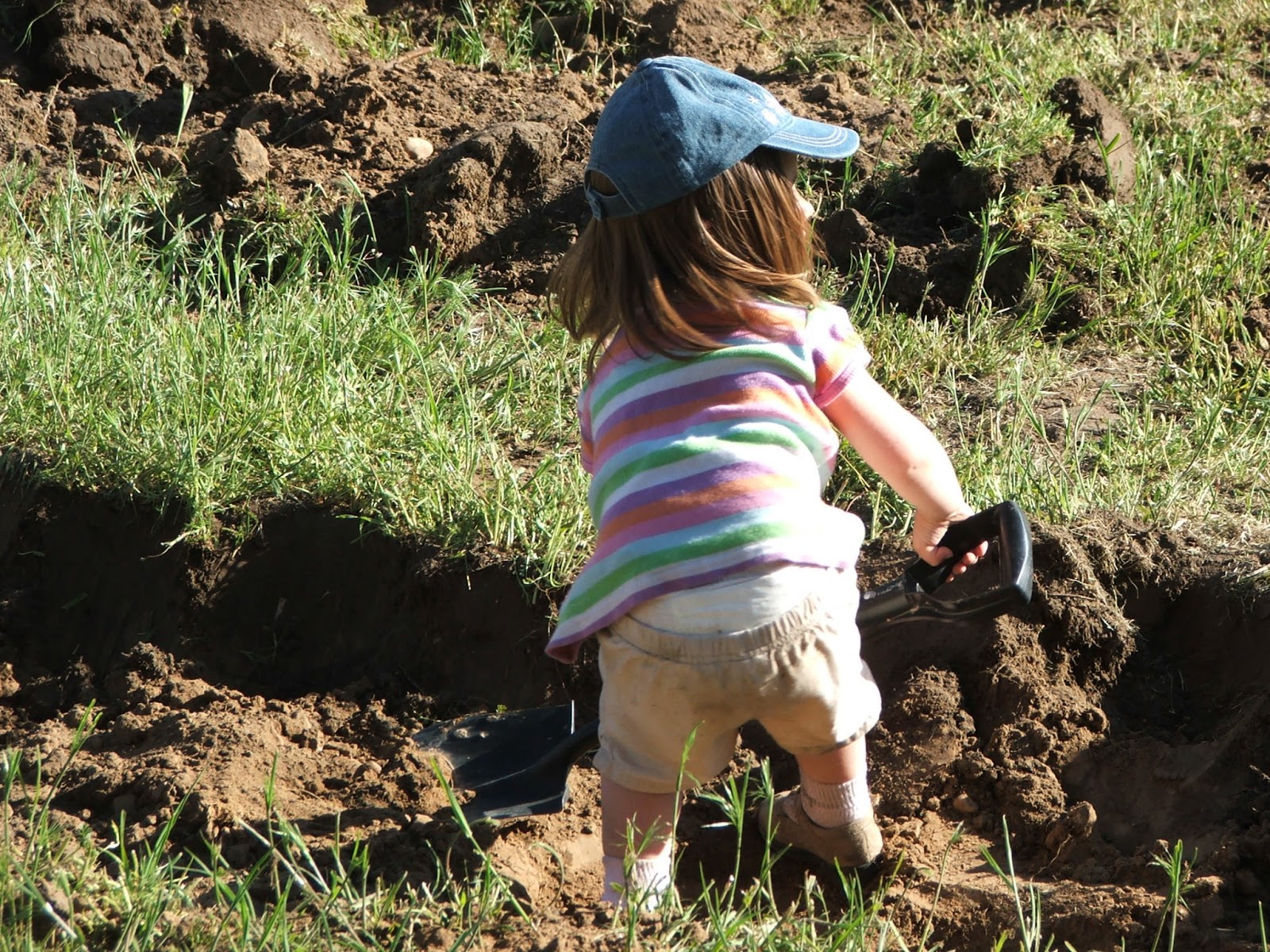
Like my niece, there are times when we just have to
hope someone will help us get out. This hope helps
us smile when we are down in the dirt.
Hope is closely related to faith and is necessary in our lives. Like faith, hope is a belief that something good will happen even though we can’t see it. The difference I see is that hope comes when something is out of your control. Let me explain.

When I was serving a two year mission for my church in South Korea, I got a letter from my parents. Luckily, I was sitting down when I started to read it because I was shocked at the news. My mom was diagnosed with breast cancer and she would be going through chemotherapy immediately. I was thousands of miles from home, without a way to get home and even if I did go home, I couldn’t do anything once I got there. So I prayed for her and I got up and went to work. I had faith that God would answer my prayer, but I had a hope that she would be OK and would recover. My actions wouldn’t have a direct impact, though I think serving God as a missionary provides some blessings, my feeling was hope.

In the more eternal perspective, we hope for eternal life. A goal we could not achieve on our own. No amount of action could gain that reward. It is only through Christ that we can get that we can be saved from our sins (Titus 3:7). This hope is what gets us through the hard times when we lose a loved one before we are ready. We need faith to keep going, and hope can fuel the flame.

Again, kids need to see our example of hope more than hear our words. Are we hopeful when times are hard? Do we speak of hope when we have just cause to lament our fate? Are we full of hope in the words of Christ?

These are interesting days, but I believe God is aware of us and our needs. He is there guiding our footsteps as we scale life’s treacherous path. He comes to us always. It is up to us to act on this belief and see God’s hand in our lives. It is up to us to look forward with hope, not in man but in the power of God (Proverbs 10:28). Then we will see God do more than we ever could on our own.

Next week: Learning through parables